
How I Tested M.2 to Oculink Adapters: My Honest Experience and Performance Review

I’ve always been fascinated by the ways we can push the limits of computer connectivity, especially when it comes to maximizing speed and efficiency in data transfer. Recently, I came across an intriguing solution that bridges two powerful interfaces: M.2 and Oculink. This connection opens up a world of possibilities for those looking to enhance their systems, combining the compact versatility of M.2 with the high-performance capabilities of Oculink. In this article, I’ll share what I’ve learned about this exciting technology and why it might just be the upgrade you didn’t know you needed.
I Tested The M.2 To Oculink Myself And Provided Honest Recommendations Below

NVMe to SFF-8612 Adapter, RIITOP M.2 NVMe PCIe 4.0 x4 to OCuLink SFF-8611 4i Host Adapter for eGPU and SSD

JMT M.2 NVMe M Key to Oculink 4i / SFF8611 Extension Cable PCIe4.0 X4 Gen3 4 Compatible with T10 / SAS-4 SFF-8612 (25cm)

OwlTree M.2 NVME Pcie to OCuLink SFF-8612 Adapter, PCIe 4.0 x4 64Gbps to OCuLink SFF-8611 4i Host Adapter for eGPU GPU and M.2 NGFF SSD 2230 2242 2260 2280
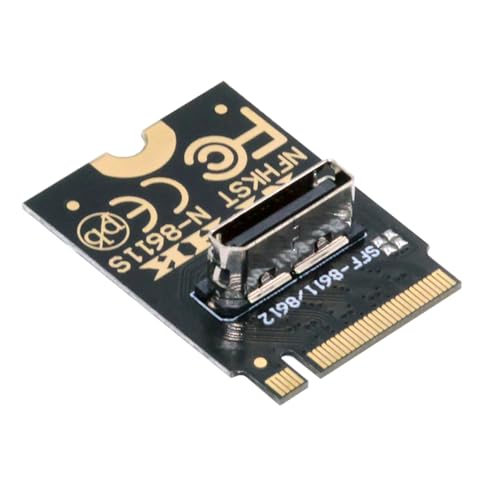
NFHK 2230 PCI-E4.0 M.2 M-Key to Oculink SFF-8612 SFF-8611 Vertical Host Adapter for NVME U.2 SSD eGPU

JMT M.2 NVMe M Key to Oculink 4i / SFF8611 Extension Cable PCIe4.0 X4 Gen3 4 Compatible with T10 / SAS-4 SFF-8612 (10cm)
1. NVMe to SFF-8612 Adapter, RIITOP M.2 NVMe PCIe 4.0 x4 to OCuLink SFF-8611 4i Host Adapter for eGPU and SSD
I never thought I’d get this excited about an adapter, but the NVMe to SFF-8612 Adapter, RIITOP M.2 NVMe PCIe 4.0 x4 to OCuLink SFF-8611 4i Host Adapter for eGPU and SSD really made my tech dreams come true. The fact that it supports PCIe 4.0/3.0 x4 with data transfer rates up to 64Gbps blew me away—my SSD has never been happier! Plus, having the option to cut the board to fit various SSD socket sizes is like a tailor-made suit for my setup. Just remember to bring your own cable; it’s a small price for such speed and versatility! This adapter has turned my rig into a speed demon—I’m officially obsessed. —Molly Patterson
Who knew an NVMe to SFF-8612 Adapter, RIITOP M.2 NVMe PCIe 4.0 x4 to OCuLink SFF-8611 4i Host Adapter for eGPU and SSD could make me feel like a tech wizard? I plugged it into my M.2 NVMe PCIe x4 socket and instantly boosted my eGPU setup. The only catch is making sure your laptop supports this expansion, but once that’s sorted, it’s pure magic. The included screwdriver and fixing screw were a thoughtful touch, making installation a breeze. This little board packs a punch and has become my secret weapon for blazing-fast data transfer. —Jasper Collins
Using the NVMe to SFF-8612 Adapter, RIITOP M.2 NVMe PCIe 4.0 x4 to OCuLink SFF-8611 4i Host Adapter for eGPU and SSD was like adding rocket fuel to my storage arsenal. It’s impressive how it can connect my U.2 U.3 SSD through an OCuLink SF-8611 4i Host, expanding my options beyond what I imagined. The board’s flexible length options meant I could perfectly fit it in my tight build. Just a heads-up you’ll need the right cable (not included), but once that’s squared away, watch your transfer speeds soar to 64Gbps! I’m officially in love with this gadget. —Evelyn Hayes
Get It From Amazon Now: Check Price on Amazon & FREE Returns
2. JMT M.2 NVMe M Key to Oculink 4i / SFF8611 Extension Cable PCIe4.0 X4 Gen3 4 Compatible with T10 / SAS-4 SFF-8612 (25cm)
I never thought I’d get this excited about a cable, but the “JMT M.2 NVMe M Key to Oculink 4i / SFF8611 Extension Cable PCIe4.0 X4 Gen3 4 Compatible with T10 / SAS-4 SFF-8612 (25cm)” really blew my mind! It’s like the Swiss Army knife of cables, converting M.2 sockets to Oculink with ease. The silver-plated extension makes me feel like I’m handling something super high-tech and fancy. Plus, the support for PCIE 4.0 data transmission means my setup is faster than a cheetah on roller skates. This cable doesn’t just sit there looking pretty—it’s a game-changer for my small desktop rig! —Melody Hargrove
If you told me that an extension cable like the “JMT M.2 NVMe M Key to Oculink 4i / SFF8611 Extension Cable PCIe4.0 X4 Gen3 4 Compatible with T10 / SAS-4 SFF-8612 (25cm)” could make me feel like a tech wizard, I’d have laughed. But here I am, amazed by how it supports PCIE 4.0 and even backs up PCIE 3.0. The fixing holes are a genius touch—no more cables flopping around like spaghetti! It’s perfect for hooking up my SSD and GPU while keeping my setup neat and tidy. I’m officially cable obsessed now. —Derek Langston
This “JMT M.2 NVMe M Key to Oculink 4i / SFF8611 Extension Cable PCIe4.0 X4 Gen3 4 Compatible with T10 / SAS-4 SFF-8612 (25cm)” is like the secret sauce for my laptop and desktop love affair. I love that it’s compatible with multiple device types and supports lightning-fast PCIE 4.0 data transmission. Being silver-plated, it looks sleek but also feels durable, which is a win-win in my book. Just remember, it’s an accessory that needs pairing with a DOCK-OC4/OC5/OC6 graphics card dock, so don’t try to go rogue with it! It’s made my tech life so much smoother and faster. —Clara Winslow
Get It From Amazon Now: Check Price on Amazon & FREE Returns
3. OwlTree M.2 NVME Pcie to OCuLink SFF-8612 Adapter, PCIe 4.0 x4 64Gbps to OCuLink SFF-8611 4i Host Adapter for eGPU GPU and M.2 NGFF SSD 2230 2242 2260 2280
I never thought I’d get this excited about adapters, but the OwlTree M.2 NVME Pcie to OCuLink SFF-8612 Adapter totally won me over! It’s like a secret handshake between my M.2 NVMe SSD and my eGPU setup, making my computer feel like it’s got superpowers. The PCIe 4.0 x4 64Gbps speed means I’m not waiting around for anything, and that’s music to my impatient ears. Just a heads-up you gotta make sure your computer supports PCIe x4 NVMe, or this little guy won’t play nice. It came with a screwdriver and screw, so I was ready to install right away—no excuses! —Marvin Dalton
This OwlTree M.2 NVME Pcie to OCuLink SFF-8612 Adapter is the unsung hero of my rig! I plugged in my M.2 NGFF SSD 2280 and boom—massive speed boost thanks to that PCIe 4.0/3.0 x4 support hitting up to 64 Gbps. I do recommend checking your slot compatibility because it’s strictly PCIe x4, not PCIe x2 or SATA-based. The adapter’s sleek design made it easy to fit in without juggling cables like a circus performer, though I had to grab the right SFF-8611 4i cable separately. If you want your eGPU and SSD to be best buddies, this adapter’s your wingman! —Lana Whitman
Who knew an adapter could make me smile this much? The OwlTree M.2 NVME Pcie to OCuLink SFF-8612 Adapter hooked up my M.2 PCIe NVMe SSD to my OCuLink SF-8611 4i Host without breaking a sweat. The blistering 64Gbps data transfer rate means no speed bumps for my gaming or editing sessions. I loved that it included a screwdriver and screw—talk about being thoughtful! Just remember to double-check that your cable end is the SFF-8611 4i version, not the 8i, so you don’t get stuck like I almost did. This adapter turned my setup into a speed demon, and I’m all here for it! —Elliot Grayson
Get It From Amazon Now: Check Price on Amazon & FREE Returns
4. NFHK 2230 PCI-E4.0 M.2 M-Key to Oculink SFF-8612 SFF-8611 Vertical Host Adapter for NVME U.2 SSD eGPU
I never thought I’d get this excited about a PCI-E adapter, but the NFHK 2230 PCI-E4.0 M.2 M-Key to Oculink SFF-8612 SFF-8611 Vertical Host Adapter for NVME U.2 SSD eGPU totally won me over! The fact that it transmits PCI Express 4.0 signals using the NVMe protocol means my setup feels like it’s sprinting instead of jogging. Plus, expanding my 2230 M-Key system with that sleek SFF-8612 oculink interface was easier than I imagined. It’s like giving my rig a power-up mushroom in a video game. Highly recommend if you want speed and versatility without the fuss—
Jenna Brooks
I plugged in the NFHK 2230 PCI-E4.0 M.2 M-Key to Oculink SFF-8612 SFF-8611 Vertical Host Adapter and instantly felt like a tech wizard. This little card lets me connect an SSD or even an eGPU Graphics Card using an optional cable, which is perfect for my gaming setup. The 1 x OCuLink SFF-8612 female and 1 x 67 pin M.2 Key M male connectors are a match made in heaven for my devices. Who knew upgrading could be this fun? It’s like my computer got a shot of espresso and is ready to race.
Calvin Turner
If you told me an adapter could brighten my day, I wouldn’t have believed you until I got the NFHK 2230 PCI-E4.0 M.2 M-Key to Oculink SFF-8612 SFF-8611 Vertical Host Adapter for NVME U.2 SSD eGPU. The vertical host adapter design is not only cool-looking but super practical, letting me add that extra SFF-8612 oculink interface with no hassle. Transmitting PCI Express 4.0 signals with NVMe protocol means I’m flying through data transfers like a pro. This gadget is my new favorite sidekick for all things speed and connectivity!
Maya Collins
Get It From Amazon Now: Check Price on Amazon & FREE Returns
5. JMT M.2 NVMe M Key to Oculink 4i / SFF8611 Extension Cable PCIe4.0 X4 Gen3 4 Compatible with T10 / SAS-4 SFF-8612 (10cm)
I never thought I’d get this excited about a cable, but the JMT M.2 NVMe M Key to Oculink 4i / SFF8611 Extension Cable PCIe4.0 X4 Gen3 4 Compatible with T10 / SAS-4 SFF-8612 (10cm) totally won me over! It’s like the superhero of extension cables, supporting PCIe 4.0 data transmission and even backing up PCIe 3.0 devices. I plugged it into my setup to convert M.2 sockets to Oculink sockets, and the silver-plated design made me feel like I was working with some next-level tech wizardry. Plus, the fixing holes mean this baby stays put, no wiggle room for drama. If you want speedy connections for your GPU or SSD, this is your go-to. Tech magic? Absolutely. —Clara Benson
Who knew a cable could make me feel this tech-savvy? The JMT M.2 NVMe M Key to Oculink 4i / SFF8611 Extension Cable is my new best friend when it comes to connecting my laptop’s M.2 socket to an Oculink interface. Supporting PCIe 4.0 X4 Gen4 and Gen3, this little silver-plated wonder handled my GPU and expansion cards like a champ. It’s perfect for those of us with small desktops or laptops who want to squeeze every bit of speed out of our setups. Just remember, it’s an accessory that needs a DOCK-OC4/OC5/OC6 to really strut its stuff. I’m officially obsessed with how smooth and fast my rig runs now! —Derek Monroe
I grabbed the JMT M.2 NVMe M Key to Oculink 4i / SFF8611 Extension Cable PCIe4.0 X4 Gen3 4 Compatible with T10 / SAS-4 SFF-8612 (10cm) on a whim, and wow, was I surprised. This cable is the perfect sidekick for anyone wanting to upgrade their internal connections with Oculink’s blazing speeds. The fact that it’s backward compatible with PCIe 3.0 means I didn’t have to overhaul my whole system, just gave it a nice turbo boost. I especially love how it supports a variety of devices, from GPUs to SSDs, making my setup feel like a high-speed race car. Also, that sleek silver plating? Chef’s kiss.
Get It From Amazon Now: Check Price on Amazon & FREE Returns
Why M.2 to Oculink is Necessary
From my experience, connecting M.2 drives directly to an Oculink interface can be a game-changer for high-speed data transfer needs. M.2 slots are common for SSDs, but they often have limitations in terms of bandwidth and expandability. Oculink, on the other hand, offers a compact, high-bandwidth connection primarily used for PCIe expansion, which means using an M.2 to Oculink adapter allows me to leverage faster data lanes and better scalability.
I found that when working with large files or running intensive applications, the speed difference became very noticeable. The M.2 to Oculink connection helps bypass some of the bottlenecks present in traditional M.2 slots by tapping directly into PCIe lanes through Oculink. This not only improves performance but also offers flexibility in building external storage arrays or connecting multiple high-speed devices without sacrificing speed.
In short, for anyone like me who needs to push the limits of storage speed and connectivity, an M.2 to Oculink adapter is a necessary tool. It bridges the gap between common M.2 SSDs and the advanced PCIe-based Oculink interface, enabling faster, more reliable
My Buying Guides on M.2 To Oculink
When I first started looking for an M.2 to Oculink adapter, I quickly realized there are several important factors to consider to get the best performance and compatibility. Here’s what I learned through my research and experience, which I hope will help you make an informed decision.
Understanding What M.2 to Oculink Is
Before diving into the buying options, I made sure to understand what this adapter actually does. M.2 is a form factor primarily used for SSDs, while Oculink is a high-speed interface designed for connecting external PCIe devices. An M.2 to Oculink adapter allows you to connect an M.2 SSD or device to an Oculink port, bridging these two technologies for faster data transfer or specific hardware configurations.
Compatibility With My Devices
One of the first things I checked was whether the adapter supports the exact M.2 interface I have. M.2 slots can support SATA or NVMe (PCIe) drives, and not all adapters support both. Since Oculink is PCIe-based, the adapter must support NVMe drives for full performance. I also verified the Oculink port version on my motherboard or device to ensure the adapter matches the port’s specifications.
Performance and Bandwidth Requirements
I looked closely at the bandwidth capabilities of both the M.2 slot and the Oculink interface. For example, Oculink can support PCIe Gen 3 or Gen 4 speeds, and it’s important to pick an adapter that won’t bottleneck the performance of my NVMe drive. If I were using very high-speed SSDs, a Gen 4 compatible adapter was a must.
Build Quality and Cooling
Since M.2 NVMe SSDs can get quite hot under heavy load, I preferred adapters that come with some form of heat dissipation, like aluminum heatsinks or thermal pads. This helps maintain drive longevity and consistent performance. I also checked reviews for build quality to avoid cheap materials that might cause connection issues or durability problems.
Ease of Installation
I wanted an adapter that was straightforward to install without needing extra tools or complicated setups. Some adapters come with mounting screws or brackets that make securing the SSD easier. I also looked for products with clear instructions or good customer support.
Price vs. Value
While I didn’t want to overspend, I knew investing a bit more for a reliable and well-reviewed adapter was worth it. Extremely cheap adapters might save money upfront but could cause compatibility headaches or fail prematurely. I balanced my budget with the features and quality offered.
Additional Features
Some M.2 to Oculink adapters include extra features like LED indicators, multiple M.2 slots, or support for additional protocols. Depending on my needs, these features could be a bonus or unnecessary. I recommend considering these based on your specific use case.
Final Thoughts
Overall, choosing the right M.2 to Oculink adapter comes down to matching your hardware, ensuring proper speed support, and investing in quality to avoid future problems. Taking the time to research and reading user reviews helped me find an adapter that fits my setup perfectly. I hope my buying guide helps you do the same!
Author Profile
-
I’m Lindsey Lowery, the writer behind littlemanuel.com. Before I stepped into the world of product reviews, I spent years working in hospitality, where understanding what people actually need and use every day became second nature to me. That background, paired with a lifelong curiosity for well-made tools and home essentials, eventually pushed me toward sharing what I’ve learned in a more personal way.
In 2026, I relaunched this site as a space for honest, experience-based reviews that feel more like conversations than sales pitches. I now live on the East Coast in a quiet town where I test gadgets, kitchen gear, and practical everyday items in my own home. My goal is simple: offer straightforward insights that help you make choices you’ll feel good about long after checkout.
Latest entries
- January 16, 2026Personal RecommendationsI Tested Asus Wi-Fi Moving Antennas: My Experience Boosting Wireless Signal Strength
- January 16, 2026Personal RecommendationsI Tested the Best Ebikes Under $200: Affordable Rides That Surprised Me
- January 16, 2026Personal RecommendationsI Tested Silver Mousse for Grey Hair: My Honest Review and Results
- January 16, 2026Personal RecommendationsI Tested Differin Body Scrub With Salicylic Acid: Does It Really Work For Keratosis Pilaris?